
How Traffic Warrants Work in Floyd County
Floyd traffic cases are handled by General District Court, not a separate Town of Floyd municipal court. A missed date or unpaid obligation can lead to process, but the outcome depends on the charge and the court's order. A traffic infraction has a specific limit on when a warrant may issue.
Virginia Code section 46.2-938 addresses failure to comply with certain summonses and permits a warrant in the circumstances it covers. Section 19.2-258.1 says an infraction alone cannot produce that warrant solely because a person failed to enter an appearance. Ask the clerk which rule matches the citation.
Floyd County Ticket Search Fields
The official GDC payment and case interface supports a Floyd court selection, name, case number, and hearing-date search. It has no public warrant-type dropdown or documented live warrant-status field. “Mark For Payment” appears only for eligible cases and is a payment action.
| Field or action | Type | What it does | Floyd note |
|---|---|---|---|
| Court | Selection | Sets the court | Choose Floyd General District Court. |
| Name | Text | Finds a case | Last, first, and middle name as on the summons. |
| Case number | Text | Finds one case | Use the exact number if known. |
| Hearing date | Date/search | Finds a setting | Available as an alternative search choice. |
| Mark For Payment | Result action | Selects eligible cases | Does not show that a warrant was recalled. |
Floyd County Traffic Warrant Checks
Use the state GDC system for a case search, then speak with the Floyd clerk if the result mentions a missed date, capias, or balance. The courthouse clerk is the source for the court record; the sheriff is the contact for service details. No separate town citation portal was located.
- Open the Virginia GDC case and payment system and select Floyd General District Court.
- Search by name, exact case number, or hearing date; use the spelling on the citation.
- Call the Room 208 clerk about a warrant, capias, hearing, or payment term not shown online.
- Ask the sheriff about service only after identifying the court process; call before appearing in person.
- If you need a public record, request a specific existing docket or return from the clerk or sheriff.
Floyd County Payment Has Its Own Timing
Before court, an eligible online payment can waive a hearing and count as a guilty plea under the state instructions. After court, the payment system does not accept payment on the trial date; it updates overnight and accepts post-court payment from 6:00 a.m. the next day. Those timing rules describe payment processing, not warrant status.
The Virginia traffic case instructions explain the court selector and “Mark For Payment” step. The screenshot below is the official traffic payment route. It allows up to five eligible cases on a receipt and adds a 4% fee to online credit or debit transactions.
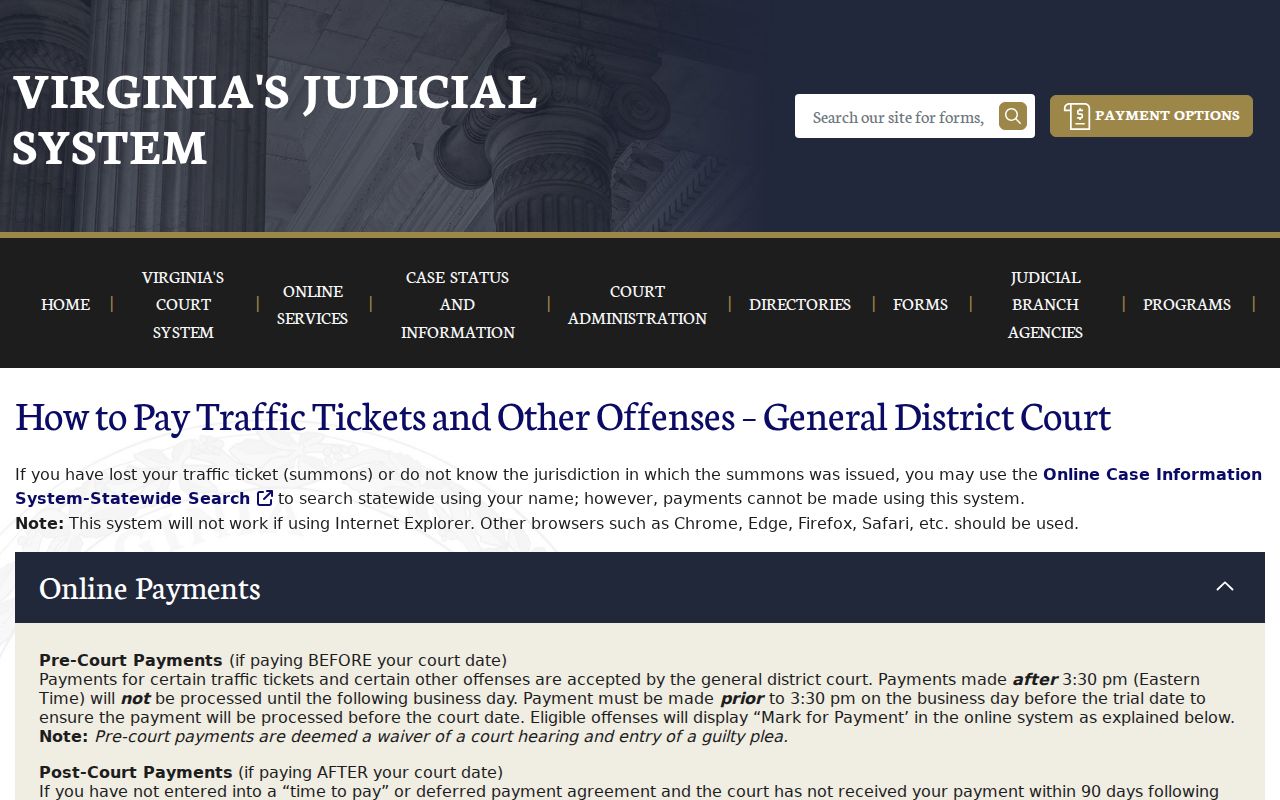
Call Room 208 if a capias appears or payment follows a missed date. A payment receipt does not show that a judge withdrew separate process.
Traffic Warrants: What They Show
The public instructions describe case-search fields, not a warrant-specific traffic record. A paper may link the citation, charge, court, and hearing date. Floyd County has no public warrant-number format or status code guide, so copy the number from the citation and have the clerk identify the process.
| Citation number | Copy from the court paper; no local warrant number format is published. |
|---|---|
| Charge | Offense and code reference tied to the citation or criminal traffic case. |
| Court | Floyd General District Court for local traffic matters. |
| Payment action | “Mark For Payment” may appear when the case is eligible. |
| Process status | Ask whether a warrant or capias was issued, served, returned, or recalled. |
Floyd County Clerk Confirms Recall
When an online case shows “Mark For Payment,” ask whether the case is pre-court or post-court and whether any separate process remains. Floyd GDC links to a local deferred or installment payment policy, but its PDF was not readable in the research. The clerk can explain the terms and the correct filing or payment route.
Virginia court instructions list personal check, money order, certified check, and credit card as district-court payment methods, but tell users to confirm card acceptance locally. A local payment plan or a completed payment does not itself prove a capias was recalled.
The official payment-policy hub explains that each court adopts its own deferred and installment policy. The capture below links to the state guidance for the Floyd court.
The linked Virginia courts payment-policy page is the source for the local deferred and installment guidance pictured below. Call the clerk about the terms for a particular Floyd case.
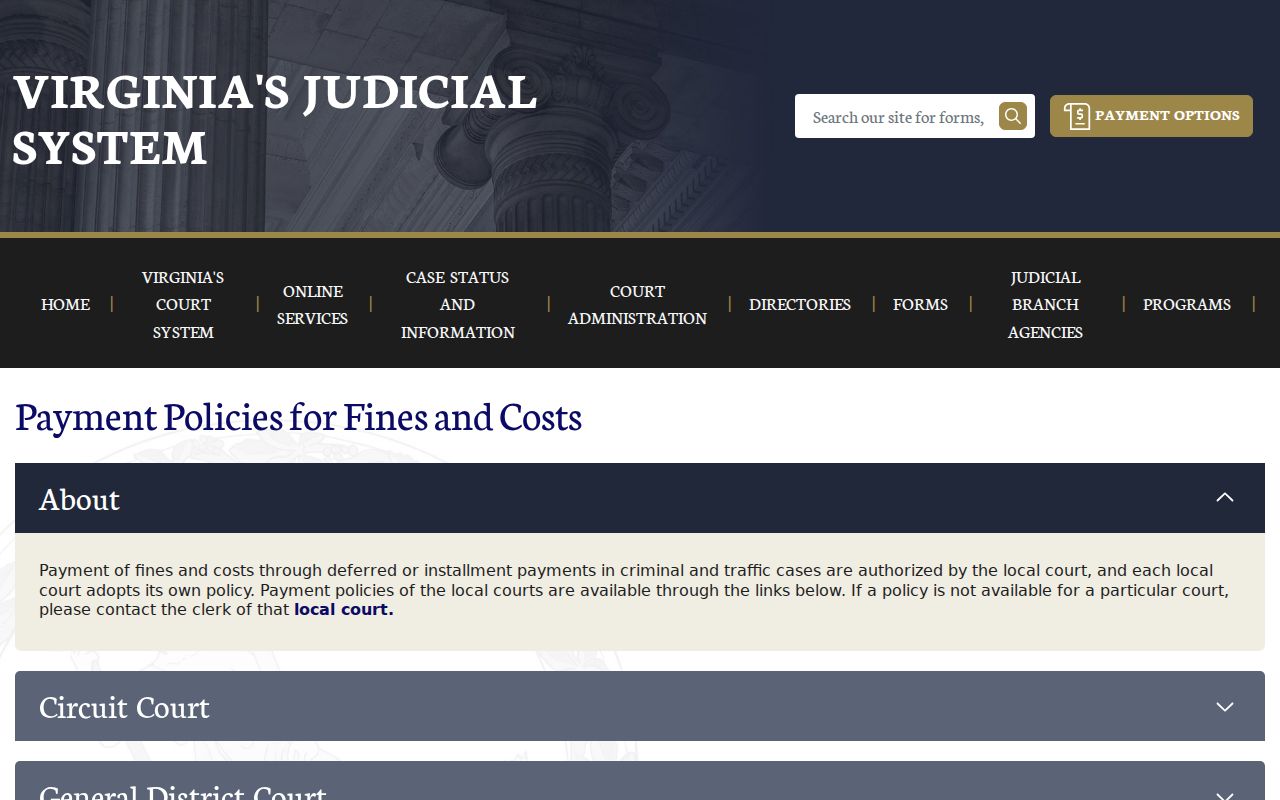
Keep the receipt and call the clerk to confirm the specific process, return date, and any balance that remains.
Clearing a Floyd County Traffic Warrant
Payment can resolve a court balance, while a judge may need to recall a capias separately. Ask the clerk which action is required before paying or appearing. Virginia's local payment-policy hub leaves payment-plan terms to the court; Floyd's linked policy PDF could not be read, so call the clerk for details.
- Ask Room 208 for the case balance, process type, and next court date.
- Confirm which payment methods the court accepts and whether payment waives a hearing.
- If the case has a capias, ask whether a judge's order, bond, or appearance is also required.
- Keep the payment receipt and confirm the warrant or capias itself was recalled or satisfied.
Warning: Do not assume a payment removes a separate capias. Ask the clerk to confirm recall and any next hearing before treating the court process as closed.
Virginia DMV Fine Rule Changed
Since July 1, 2019, Virginia courts cannot suspend driving privileges solely because court fines or costs remain unpaid. That rule did not cancel the debt or remove other suspension categories. Child-support compliance and some failure-to-appear processes remain separate.
The Virginia DMV fine-and-cost page explains the change. The image shows that official guidance. Ask the Floyd clerk whether a specific traffic case has a current court process or a separate license-related consequence.
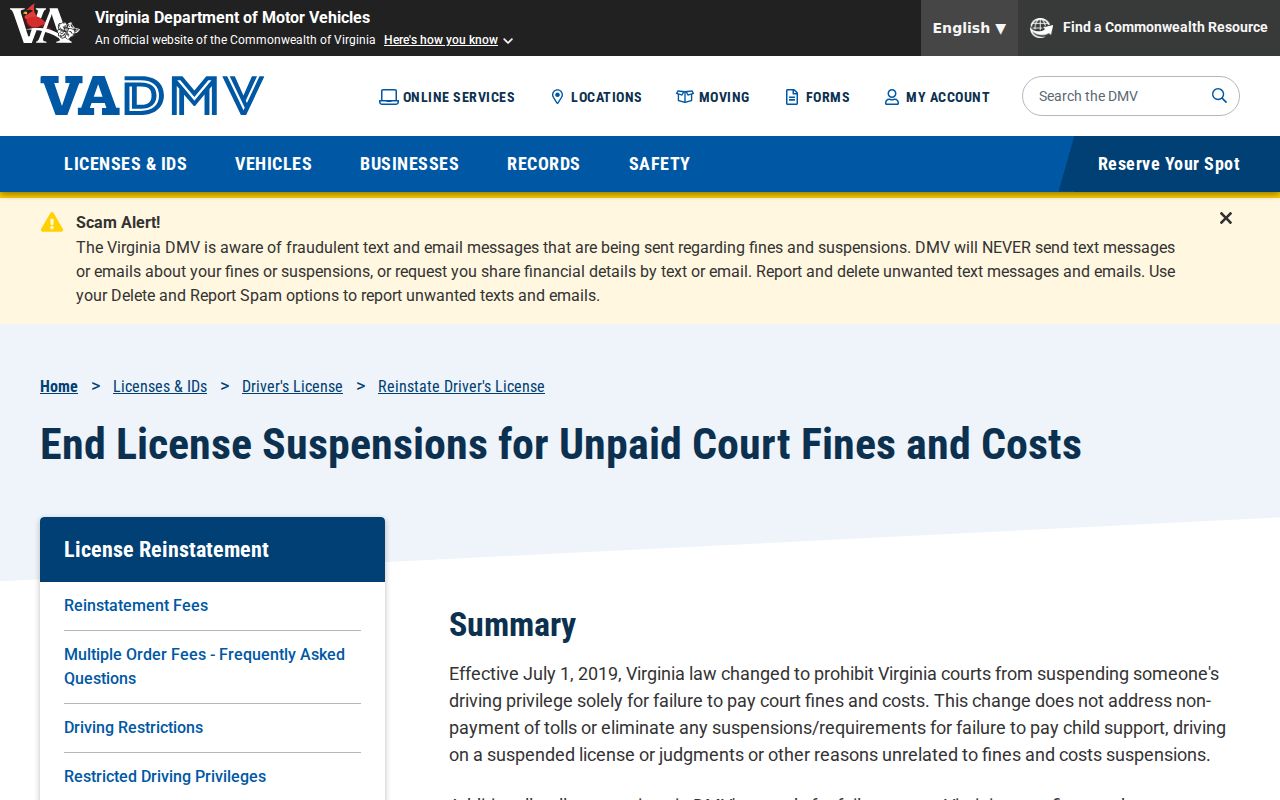
This traffic page concerns court process and payment. A DMV summary cannot replace the clerk's confirmation that a warrant or capias was recalled.
Floyd County Traffic Infractions Have a Narrow Rule
Virginia law treats a traffic infraction differently from a misdemeanor. Under Code § 19.2-258.1, a warrant may not issue solely because a person charged with an infraction failed to appear or failed to send the required written response. That narrow rule does not resolve a separate misdemeanor, another charge, or process already issued for a different reason. Ask the Floyd clerk what the actual case docket shows before assuming a missed traffic date created a warrant—or that no other process exists.
How Traffic Warrants Trigger License Holds
A warrant is court process. An FTA describes a missed obligation and may lead to additional court action. A license suspension is a separate legal consequence. Virginia's infraction rule, misdemeanor rules, and DMV limits must be read with the actual charge rather than treated as one automatic result.
| Mechanism | What Triggers It | What It Does |
|---|---|---|
| Traffic warrant | Court process under the applicable statute | May authorize arrest; confirm with the issuing court. |
| Failure to appear | Missed court duty, subject to the charge and rule | Can prompt a separate hearing or capias. |
| Fine or cost balance | Unpaid court obligation | Not by itself a court license suspension after the 2019 change. |